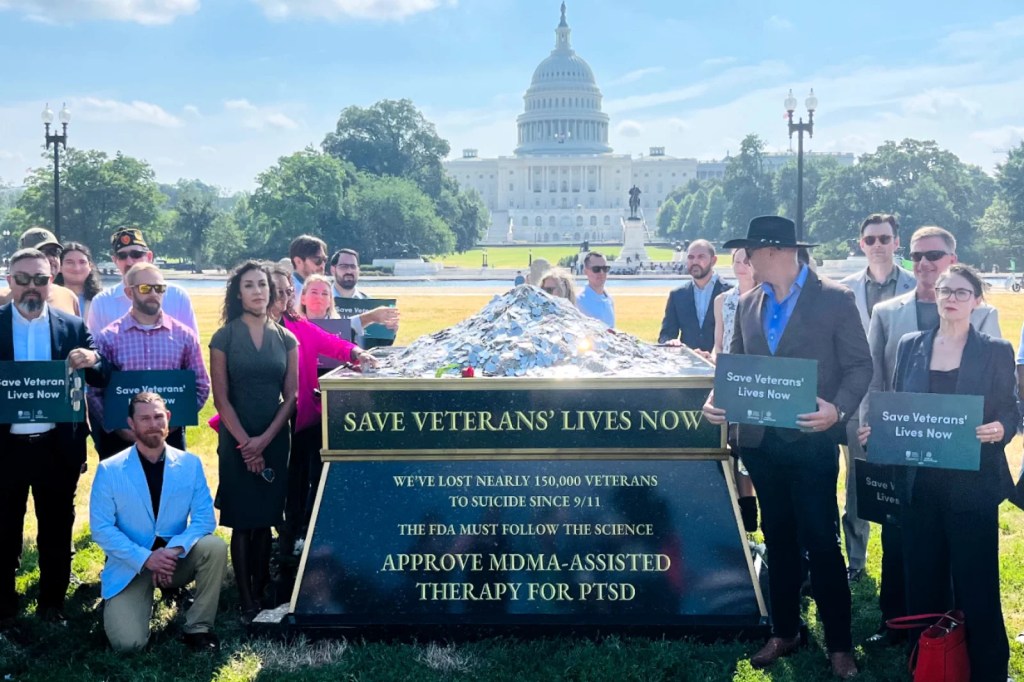
It is with a heavy heart and a deep sense of urgency that I reiterate a narrative that is pervasive, tragic, and preventable: the interrelated crises of veteran suicide and PTSD.
Many speak of these issues as though they are mere policy matters requiring a resolution. But as a Marine Corps veteran who dedicated 16 years of service to this country, with deployments to Iraq and Afghanistan, I’ve lost too many friends – and suffered too much myself – to depersonalize it in such a way. For my veteran brothers and sisters, this is not just a matter of numbers or another policy debate to be had; it is a moral imperative that calls for immediate and decisive action by our national leaders, specifically the President and his appointed FDA Commissioner.
Our nation loses between 6,000 and 16,000 veterans to suicide each year. Behind these staggering figures are stories of unbearable pain and suffering often triggered by a PTSD diagnosis. Despite twenty-plus years of effort and billions of federal dollars that have been dedicated to addressing this mental health disorder, progress in PTSD treatment has been dismally slow. Our inability to find a treatment that actually works has led to devastating outcomes, including homelessness, addiction, and the heart-wrenching tragedy of self-inflicted death.
It is in this context of desperation and delayed progress that I advocate for the FDA to consider the scientific evidence supporting a revolutionary advancement in PTSD treatment: MDMA-Assisted Therapy (MDMA-AT). The agency has already acknowledged MDMA-AT’s remarkable promise, with its designation of the treatment as a “Breakthrough Therapy” in 2017. Over the past seven years, the FDA has worked with the drug’s sponsor to ensure that its clinical trials were properly designed to give them the data they needed to determine whether MDMA-AT should be approved.
The results from Phase Three clinical trials are nothing short of remarkable: 71% of participants no longer qualified for a PTSD diagnosis, and 86% showed clinically significant improvement in their symptoms. These outcomes represent nearly double the efficacy of existing PTSD treatments, the last of which was approved in 2001 – almost 25 years ago.
To be clear, my reason for urging FDA approval of MDMA-AT is rooted in more than data, statistics, and scientific achievements. While MDMA-AT is sufficiently backed by all three, for me, this is about providing the 13 million Americans who suffer from PTSD with an opportunity to find hope where there has been only despair. It is about giving those who’ve sacrificed so much for our country a lifeline with verifiable efficacy. And it is ultimately, and specifically, above all, about saving veteran lives.
That’s why veterans and their families have led the charge in advocating for FDA approval of MDMA-AT, but they are far from alone in their appeals. Three of the “Big Six” VSOs, as well as the IAVA and Wounded Warriors Project, have publicly voiced their support for MDMA-AT. A bipartisan coalition of lawmakers have hosted press conferences on the steps of the Capitol, issued public statements, and signed their names to letters urging the President and FDA commissioner to approve MDMA-AT this August. And the VA’s own Under Secretary of Health, Dr. Shereef Elnahal, has publicly stated that his agency is ready to start rolling out MDMA-AT as soon as regulators approve it. The consensus among PTSD experts and those who’ve made it their lives’ missions to care for our veterans is overwhelming, both in drawing attention to veteran PTSD and suicide rates and in support of MDMA-AT’s approval.
In our hyper-politicized environment, it is rare to find common ground on much, if anything, these days. Yet, FDA approval of MDMA-AT is one of the few things that policymakers on both sides of the aisle agree on. Our need for effective new PTSD treatments is long overdue, and our veterans can’t wait any longer for the scientifically proven hope that MDMA-AT offers.
In addressing this crisis, we must remember that each statistic represents an actual person – someone’s friend, son, daughter, father, or mother – whose life has been affected or cut short by a condition that MDMA-AT can treat and potentially eliminate. That’s why the human cost of FDA inaction is simply far too great, considering the fact that 17-44 veteran lives are lost to suicide each day. Millions of lives hang in the balance of the FDA’s willingness to seize this moment and approve MDMA-AT. It is time to make this groundbreaking treatment available to those who need and deserve it most.
On behalf of a Marine Corps veteran who serves as the Director of Public Policy for a veteran advocacy organization for Veterans Day 2024.
 SPOTLIGHT COMMUNICATIONS
Leave a comment